Ideal transformer
For simplification or approximation purposes, it is very common to analyze the transformer as an ideal transformer model as presented in the two images. An ideal transformer is a theoretical, linear transformer that is lossless and perfectly coupled; that is, there are no energy losses and flux is completely confined within the magnetic core. Perfect coupling implies infinitely high core magnetic permeability and winding inductances and zero net magnetomotive force.
A varying current in the transformer's primary winding creates a varying magnetic flux in the core and a varying magnetic field impinging on the secondary winding. This varying magnetic field at the secondary induces a varying electromotive force(EMF) or voltage in the secondary winding. The primary and secondary windings are wrapped around a core of infinitely high magnetic permeability[d] so that all of the magnetic flux passes through both the primary and secondary windings. With a voltage source connected to the primary winding and load impedance connected to the secondary winding, the transformer currents flow in the indicated directions. (See also Polarity.)
Ideal transformer equations (eq.)
By Faraday's law of induction:
. . . (1)[a]
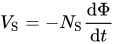 . . . (1)
. . . (2)
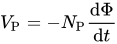 . . . (2)
Combining ratio of (1) & (2)
Turns ratio . . . (3) where
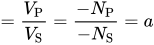 . . . (3) where
- for step-down transformers, a > 1
- for step-up transformers, a < 1
By law of conservation of energy, apparent,real and reactive power are each conserved in the input and output
. . . (4)
 . . . (4)
. (5)
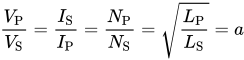 . (5)
. (5)
By Ohm's law and ideal transformer identity
. . . (6)
 . . . (6)
Apparent load impedance Z'L (ZL referred to the primary)

The transformer winding voltage ratio is thus shown to be directly proportional to the winding turns ratio according to eq. (3).[11][12][g][h]According to Faraday's Law, since the same magnetic flux passes through both the primary and secondary windings in an ideal transformer,[7] a voltage is induced in each winding, according to eq. (1) in the secondary winding case, according to eq. (2) in the primary winding case.[8] The primary EMF is sometimes termed counter EMF.[9][10][f] This is in accordance withLenz's law, which states that induction of EMF always opposes development of any such change in magnetic field.
According to the law of conservation of energy, any load impedance connected to the ideal transformer's secondary winding results in conservation of apparent, real and reactive power consistent with eq. (4).

The ideal transformer identity shown in eq. (5) is a reasonable approximation for the typical commercial transformer, with voltage ratio and winding turns ratio both being inversely proportional to the corresponding current ratio.
By Ohm's law and the ideal transformer identity:
- the secondary circuit load impedance can be expressed as eq. (6)
- the apparent load impedance referred to the primary circuit is derived in eq. (7) to be equal to the turns ratio squared times the secondary circuit load impedance.[15][16]
Polarity
A dot convention is often used in transformer circuit diagrams, nameplates or terminal markings to define the relative polarity of transformer windings. Positively increasing instantaneous current entering the primary winding's dot end induces positive polarity voltage at the secondary winding's dot end.[17][18][19][i][j][k]

